
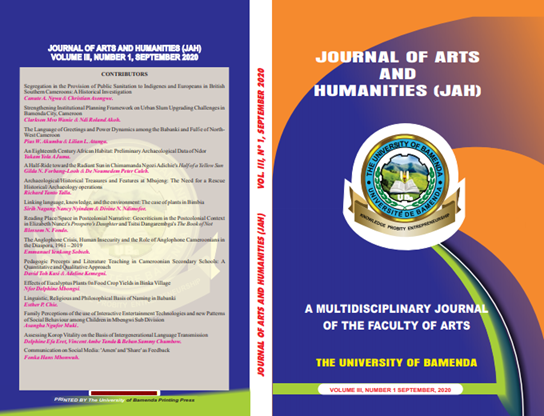
The Language of Greetings and Power Dynamics among the Babanki and Fulɓe of North-West Cameroon
Keywords:
Language contact, greetings, power dynamics, Babanki, FulɓeAbstract
The Babanki and Fulɓe of North-West Cameroon live together and interact with each other on a regular basis necessitating an incessant exchange of greetings. However, the two communities have distinct ways of greeting which come into contact when individuals from both groups meet. This study seeks to determine the manner in which the two cultures interact during greetings, paying attention to the influence exerted by the participants from each community. Data collected through observation of real life greeting situations in Badem, Babanki Tungo provide evidence that the larger, more powerful host community (Babanki) members tend to be controlled more in a greeting context than the minority pastoral Fulɓe group members who moved only recently into the Babanki community. This leads us to reconsider the traditional understanding that the host group is more likely to dominate and influence the new comers in situations of contact both in terms of language and culture. This study provides a new perspective to contact linguistics which has tended to focus on contact induced change on grammatical systems (Siemund and Kintana 2008) while neglecting socio-cultural changes that might result from language contact. Although this is a classic situation of a study of language in contact, a critical discourse analysis of interactions will give greater insights into language and power relations during such cross ethnic linguistic interactions.
Published
How to Cite
Issue
Section
All articles published in the Journal of Arts and Humanities are fully open access: immediately freely available to read, download and share. Articles are published under the terms of a Creative Commons Attribution-NonCommercial-ShareAlike 4.0 International (CC BY-NC-SA 4.0) Creative Commons license which permits use, distribution and reproduction in any medium, provided the original work is properly cited.